
What is the Value Mapping module?
The Value Mapping module in Supplier Data Manager (SDM) transforms supplier-provided attribute values into the standardized values used in your catalog. It remembers your mappings and applies them automatically to future data imports, keeping your data consistent with your taxonomy over time.
Example:
Suppliers might send color values like "Light Blue" or "Duck Blue." With the Value Mapping module, you can map these variations to your preferred term, such as "Blue," creating consistency across your catalog.

The screenshot above shows the Value Mapping module with supplier color values on the right and standardized catalog options on the left, connected by drag-and-drop mappings.
The Value Mapping module is particularly useful for "select" attribute types that can have multiple options.
You can consolidate multiple supplier values into a single target value — for example, merging "Man" and "Woman" into "Unisex" for unisex clothing.
How the Value Mapping module works
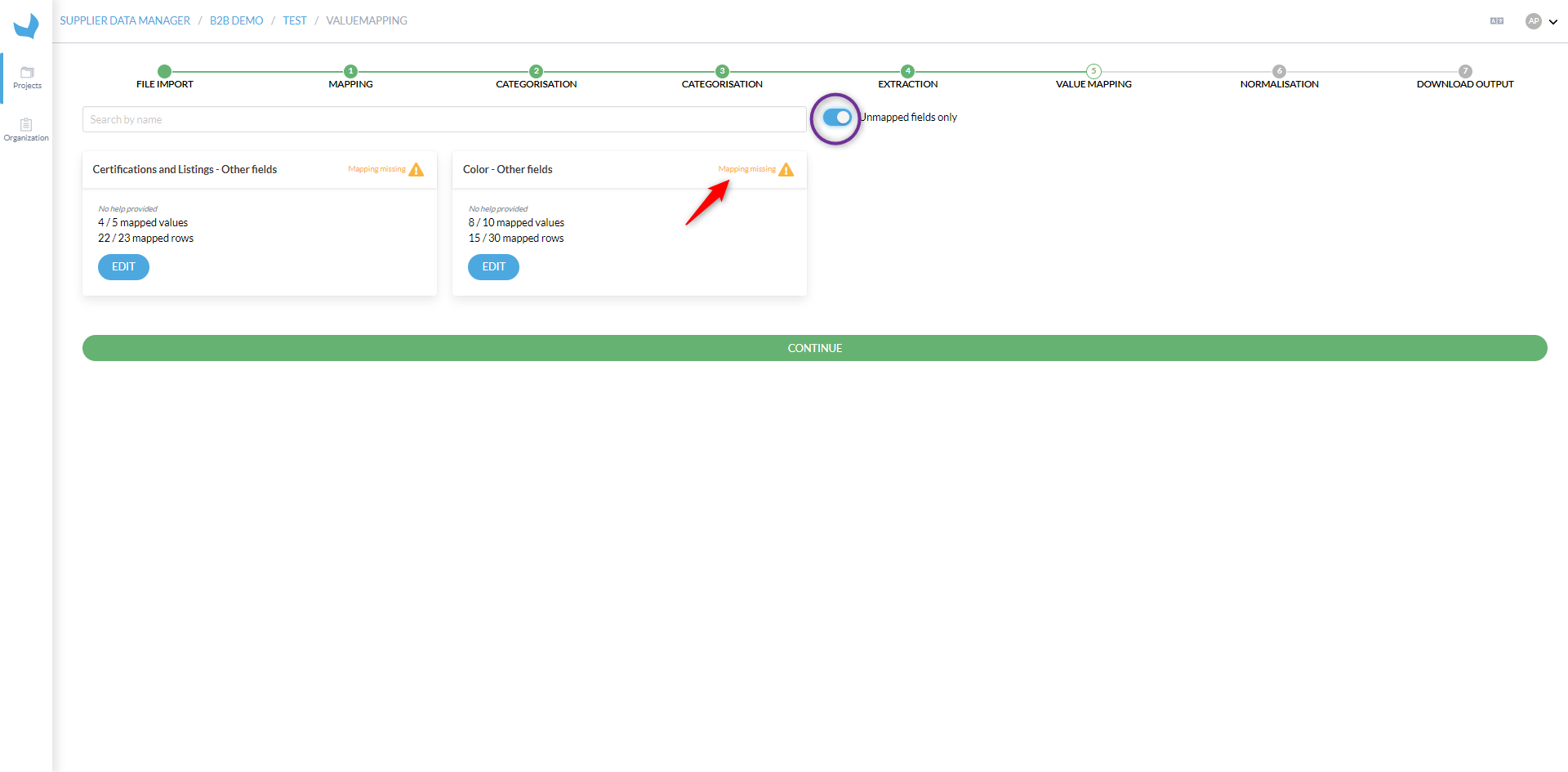
The Value Mapping module displays your select and boolean attributes with their current mapping status. By default, only unmapped fields are shown — uncheck the Unmapped fields only filter to see all fields.
When editing a field, the values to map from the supplier are on the right, and the list of available options from your catalog is on the left. Drag and drop a supplier value onto the corresponding target value to create a mapping.
Once set, the system remembers these mappings and applies them automatically to future imports.
The screenshot above shows the Value Mapping drag-and-drop interface. Supplier values appear on the right; target catalog options appear on the left. When multiple values are selected, all mapped values display with a blue border.
The example below shows the "brand" attribute with multiple targeted options from your taxonomy, illustrating why mapping is essential when received data uses different naming conventions.

The screenshot above shows the brand attribute in the Value Mapping module, with several supplier-provided brand values that must be mapped to the correct catalog options.
If a supplier value has no mapping, your admin configuration determines whether the value is retained as-is or set to null in the output. Contact your SDM administrator if you are unsure how unmapped values are handled in your setup.
If your organization reuses the same label across multiple attributes or options (for example, several families have a "Size" attribute), turn on Display attribute and option codes setting to show the code alongside each label, such as Size (size_eu).
Adding options from SDM into Akeneo PIM
To enable adding new attribute options to Akeneo PIM directly from SDM, follow the Akeneo PIM connector setup guide.
You can add new options to select-type fields (select, multi-select, and reference entities) directly from the Supplier Data Manager interface, without leaving SDM:
- Select the options you want to create.
- Click Create options.
- Review and, if needed, edit the codes and labels.
- Click Create to confirm.
Once confirmed, the new options are created in both SDM and Akeneo PIM.
Editing and deletion restrictions
- New options cannot be deleted in SDM, but can be deleted in the PIM.
- Option labels cannot be edited in SDM, but can be edited in the PIM.
- Option codes are permanent and cannot be changed in either SDM or the PIM.
Codes must be unique and may contain only letters, numbers, and underscores.